
Table of Contents
What Are the 3 Kings of SEO: Content, Links, and Technical SEO?
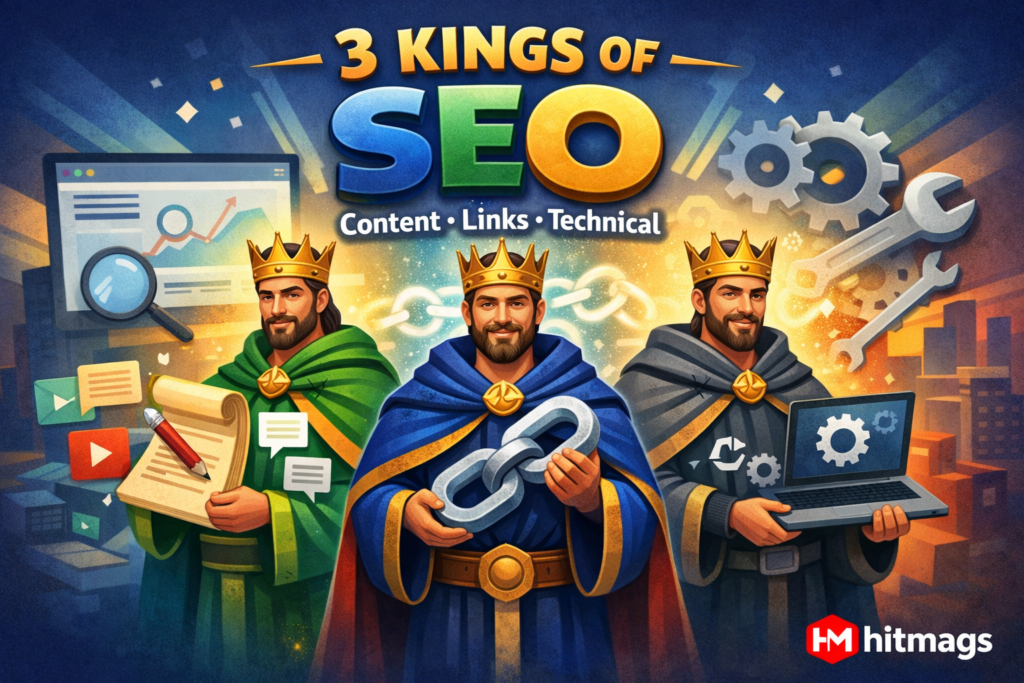
The concept of the 3 kings of SEO content links technical is one of the most important ideas in search engine optimization, and it simply means that every successful website depends on three strong pillars working together: content, links, and technical SEO. Content is what people read and what answers their questions, links are what build trust and authority for your website, and technical SEO is what makes sure your website works properly so search engines like Google can easily find and understand it. If one of these is weak, your entire SEO strategy becomes unstable, because Google does not rank websites based on just one factor anymore, it looks at the complete experience. For example, even if you write amazing content but your website is slow or broken, users will leave quickly, and your rankings will drop. In the same way, if your website is technically perfect but has no valuable content, there is nothing for users to engage with.
To understand it in a very simple way, you can think of the 3 kings of SEO content links technical like building a strong house, where content is the structure and rooms people live in, links are like recommendations from others that make your house popular, and technical SEO is the foundation and wiring that keeps everything running smoothly. Search engines use these three signals together to decide which pages deserve to rank at the top, and this is why modern SEO is not about tricks or shortcuts anymore, but about balance and quality.
Why the 3 Kings of SEO Content Links Technical Are Important
The reason the 3 kings of SEO content links technical are so important today is because search engines like Google have become much smarter and more focused on user experience than ever before, which means they no longer rank websites based on just keywords or basic optimization. Instead, they carefully analyze how helpful your content is, how trustworthy your website appears through links, and how well your site performs technically across devices and speeds. When all three elements work together, your website sends strong signals to search engines that it deserves to rank higher, because it is useful, reliable, and easy to access. This balance is what separates top-ranking websites from those that stay buried on page two or beyond, and it also explains why many websites fail even when they try SEO but ignore one of these pillars. For example, focusing only on content without building authority through links can make your site look weak in competitive niches, while ignoring technical SEO can cause slow loading speeds and poor mobile experience, which pushes users away quickly and increases bounce rates.
Another important reason why the 3 kings of SEO content links technical matter is that they support long-term growth rather than short-term results, which is essential in today’s competitive digital world where trends change quickly and algorithms update frequently. Websites that invest in all three areas tend to build a strong foundation that continues to bring traffic even without constant promotion, because their content stays relevant, their backlinks keep building trust, and their technical structure ensures smooth performance. In simple words, this approach turns your website into a long-term asset instead of a temporary project, and that is exactly what modern SEO is all about. A useful way to understand this is through a comparison of weak versus strong SEO strategies, where a weak strategy focuses on quick tricks like keyword stuffing or buying low-quality links, while a strong strategy builds high-quality content, earns natural backlinks, and maintains a technically sound website that search engines love to crawl and rank.
SEO Content Explained
SEO content is the foundation of the 3 kings of SEO content links technical, and it refers to any content on your website that is designed to provide value to readers while being optimized for search engines. This includes blog posts, guides, articles, product pages, and even landing pages. The main purpose of SEO content is to answer user questions, solve problems, and keep visitors engaged long enough to take action, whether that is reading more articles, signing up for a newsletter, or making a purchase. High-quality SEO content is not just about sprinkling keywords into sentences; it is about understanding what your audience is searching for, the problems they want solved, and the type of information they trust. For example, if someone searches for “best SEO strategies for 2026,” a well-optimized article would explain trends, practical tips, tools, and examples in a clear and easy-to-read way, ensuring that readers leave with actionable knowledge. Google and other search engines now prioritize content that demonstrates expertise, authority, and trustworthiness, so even if your content is detailed, it must be accurate, well-structured, and relevant to the searcher’s intent.
Creating effective SEO content also requires a deep understanding of user behavior, keyword intent, and readability. This means that content should be written in a natural tone, with clear headings, subheadings, and sections that allow users to scan and find information quickly. Images, infographics, and examples can make content more engaging, while internal linking to other pages on your website improves navigation and keeps readers exploring. A strong SEO content strategy also involves continuously updating existing content to reflect new trends, data, and algorithm changes, which signals to search engines that your website is active and reliable. Case studies show that websites that focus on producing comprehensive, informative, and user-focused content consistently outperform competitors that produce thin or poorly structured articles, proving that content is not just king in name but in its ability to drive traffic, build authority, and support the other two kings, links and technical SEO, for long-term success.
SEO Links Explained
SEO links are one of the most powerful components of the 3 kings of SEO content links technical, and they serve as endorsements from other websites that tell search engines your site is trustworthy and authoritative. Backlinks, or inbound links, are essentially votes of confidence that your content is valuable enough for others to reference it. The quality and relevance of these links are far more important than the quantity because a few high-authority links can significantly boost your rankings, while dozens of low-quality or spammy links can hurt your site. Links also help search engines understand the relationship between different websites and topics, creating a network of trust that allows Google to determine which sources are most reliable. Internal linking within your own website plays a similar role by guiding visitors to related content, improving engagement, and helping search engines crawl your site more efficiently. For example, a well-linked blog post on SEO content strategies can point readers to related guides on link-building or technical SEO, keeping them on your site longer and signaling to Google that your website is a comprehensive resource.
Building strong SEO links requires a thoughtful and strategic approach that focuses on value rather than shortcuts. Methods such as guest posting on relevant high-authority sites, creating shareable content, and reaching out for natural link placements are highly effective. Broken link building and digital PR campaigns can also generate authoritative backlinks when done correctly. Over time, these links not only improve your rankings but also drive referral traffic and increase your website’s visibility in your niche. However, link-building mistakes, such as purchasing links, using irrelevant anchors, or spamming directories, can lead to penalties from search engines, making it critical to focus on quality and context. Case studies show that websites that consistently earn links from respected sources while maintaining a natural internal linking structure often dominate search results because they have built a reputation for reliability and expertise, demonstrating how SEO links work hand-in-hand with high-quality content and solid technical foundations to form a complete, resilient SEO strategy that sustains long-term growth and authority online.
Technical SEO Explained
Technical SEO is the backbone of the 3 kings of SEO content links technical, ensuring that your website is not only visible to search engines but also provides a smooth and reliable experience for users. While content and links attract visitors and establish authority, technical SEO makes sure your site functions properly, loads quickly, and can be easily crawled and indexed by search engines. This includes aspects like website speed, mobile-friendliness, secure HTTPS connections, clean URL structures, XML sitemaps, and proper use of robots.txt files. Without strong technical SEO, even the best content and highest-quality links may fail to produce results because search engines cannot efficiently understand or navigate your website. For instance, if your website takes too long to load or has broken pages, users will leave before engaging with your content, and Google will notice this behavior, which can negatively impact rankings. Therefore, technical SEO is essential to support and enhance the other two pillars, creating a stable foundation that allows content and links to reach their full potential.
In addition, technical SEO has evolved to include modern considerations like structured data and schema markup, which help search engines understand the context of your content and improve the chances of appearing in rich snippets or other enhanced search results. Tools like Google Search Console, Screaming Frog, and PageSpeed Insights are commonly used to monitor technical performance, identify errors, and optimize site structure. A strong technical foundation also supports long-term SEO growth because it ensures that new content is quickly discovered and indexed, internal links function correctly, and the website maintains high performance even as it grows. Case studies of successful websites consistently show that technical SEO is not optional; sites that neglect this area often suffer from indexing issues, slow performance, and poor mobile experience, limiting the effectiveness of both content and links. By combining technical precision with valuable content and authoritative links, websites create a seamless ecosystem that maximizes search engine visibility and user satisfaction, reinforcing why the 3 kings of SEO content links technical are inseparable in a complete SEO strategy.
How All 3 Work Together
The true power of the 3 kings of SEO content links technical is realized when content, links, and technical SEO work together in harmony, creating a strong and balanced strategy that satisfies both users and search engines. Content provides the foundation by offering valuable information, answering questions, and engaging visitors, while links build authority by signaling to search engines that your website is trusted and respected within your niche. Technical SEO ensures that this content and these links are accessible, that pages load quickly, and that search engines can crawl and index the site without obstacles. When any one of these pillars is weak, the whole system suffers; for example, a website may have excellent content and strong backlinks but slow page speed or broken pages, which frustrates users and reduces rankings. Conversely, a technically flawless website with quality links but thin or irrelevant content will fail to engage readers and won’t attract natural backlinks over time. Successful SEO strategies recognize that all three pillars are interdependent and must be continuously maintained, updated, and optimized to achieve lasting results, creating a virtuous cycle where good content attracts links, technical optimization enhances performance, and backlinks reinforce authority.
A practical example of this interconnection can be seen in websites that dominate competitive search terms: they produce long-form, in-depth content that thoroughly addresses user intent, earn backlinks from respected sites that vouch for their expertise, and maintain flawless technical performance that allows pages to load in under three seconds on both mobile and desktop devices. This combination results in higher dwell time, lower bounce rates, increased organic traffic, and improved rankings in search results. Case studies also show that websites focusing on only one or two pillars rarely sustain long-term growth because search engines evaluate all aspects of a site holistically. By thinking of the 3 kings of SEO content links technical as parts of a single ecosystem rather than separate tasks, businesses can create strategies that scale efficiently, adapt to algorithm updates, and consistently outperform competitors, proving that true SEO success comes from balance, integration, and ongoing optimization rather than short-term tricks or isolated efforts.
Step-by-Step SEO Strategy
Creating an effective SEO strategy that leverages the 3 kings of SEO content links technical requires a methodical approach where each pillar supports the others in a continuous workflow. The first step begins with understanding your audience and performing thorough keyword research to identify what people are searching for and how your website can provide value. This research informs your content planning, helping you create articles, guides, and pages that answer real questions and solve problems for your target audience. Once content is created, it must be optimized with proper headings, meta tags, and descriptive alt text for images, ensuring that both users and search engines can easily understand it. At the same time, internal linking should be implemented to guide visitors through related content, increasing engagement and helping search engines navigate your website efficiently. By integrating content creation with technical optimization from the very beginning, you lay the groundwork for strong performance, while link-building strategies can begin to amplify the authority of your pages by securing quality backlinks from trusted sources in your niche.
After establishing high-quality content and a technically sound website, the next stage of a successful SEO strategy involves building and nurturing backlinks, which is the element that signals trust and authority to search engines. Link-building should focus on relevance and quality rather than quantity, using approaches such as guest posting, digital PR, and natural outreach to sites that are respected within your industry. While links are accumulating, continuous monitoring of technical SEO ensures that the website remains fast, secure, and fully indexable, preventing any issues that could hinder rankings or user experience. Analytics tools and performance trackers are used to evaluate which pages perform best, which content resonates most with the audience, and where improvements can be made, allowing the strategy to evolve based on real data. Over time, this coordinated approach of creating valuable content, earning authoritative links, and maintaining technical excellence produces compounding results: higher rankings, increased organic traffic, better engagement, and long-term growth. Case studies consistently show that websites implementing all three pillars systematically outperform competitors who neglect one or more, proving that mastery of the 3 kings of SEO content links technical is not just theory but a practical, results-driven framework for sustainable digital success.
Common Questions About the 3 Kings of SEO Content Links Technical
Many people new to SEO often wonder which of the 3 kings of SEO content links technical is the most important, but the truth is that no single pillar can guarantee success on its own. Content, links, and technical SEO are deeply interconnected, and focusing on one while ignoring the others often leads to disappointing results. For instance, you could write excellent, comprehensive content, but without backlinks from authoritative sites, search engines may not recognize your site as trustworthy, and rankings will stagnate. Similarly, you could have an impeccably fast, mobile-friendly site with strong backlinks, but if the content does not provide real value to users, visitors will leave quickly, increasing bounce rates and signaling to search engines that the site may not be relevant. Other common questions revolve around whether it is possible to rank without backlinks, how long SEO takes to produce results, and whether technical SEO is necessary for beginners. The answer to all of these is that while partial strategies might yield some traffic, long-term, sustainable success requires a balanced approach where all three kings are nurtured and maintained consistently over time.
People also ask about the role of updates, and the answer lies in the fact that SEO is not a one-time effort but a continuous process. Content must be refreshed to remain relevant, links need monitoring to ensure they remain active and authoritative, and technical SEO requires regular audits to fix broken links, improve speed, and maintain structured data. For example, a website that regularly updates its blog posts with new insights, monitors backlinks for quality, and keeps its site technically sound tends to perform far better than one that publishes content once and ignores maintenance. Analytics and performance tracking become essential tools in this process, helping website owners see what is working, which pages need improvement, and how to adapt their strategy to changing trends or algorithm updates. Ultimately, understanding and consistently applying the principles behind the 3 kings of SEO content links technical empowers businesses to make informed decisions, build authority, attract loyal visitors, and achieve sustainable growth that continues to benefit their website well into the future.
Final Thoughts: Mastering the 3 Kings of SEO Content Links Technical
Mastering the 3 kings of SEO content links technical is not just about learning individual strategies for content, backlinks, or technical optimization, but about understanding how these elements work together to create a powerful and sustainable SEO ecosystem. Content serves as the foundation, providing value, insight, and solutions to users’ problems, while links amplify that content’s authority by showing search engines that other trusted sites consider it worthy of reference. Technical SEO ensures that both content and links can be effectively discovered, indexed, and presented to users in the fastest and most accessible way possible. Ignoring any one of these pillars weakens the overall structure, reducing the potential impact of your SEO efforts and limiting the growth and visibility of your website. Websites that invest in high-quality content, earn authoritative backlinks, and maintain excellent technical performance consistently outperform competitors, proving that success comes from balance, integration, and ongoing optimization rather than short-term tricks or isolated efforts.
Looking ahead, the future of SEO continues to evolve with the rise of AI, machine learning, and search engines that are increasingly focused on user experience, relevance, and intent. Businesses and website owners who commit to mastering the 3 kings of SEO content links technical will find that their websites not only rank higher in search results but also provide better experiences for their visitors, leading to stronger engagement, more conversions, and long-term growth. Regularly analyzing performance, staying updated with algorithm changes, and adapting strategies to meet evolving search trends ensures that your SEO efforts remain effective over time. By treating content, links, and technical SEO as interdependent pillars rather than separate tasks, you create a resilient and adaptable digital presence capable of competing in any niche. Ultimately, embracing the full power of these three kings transforms your website into a trusted resource, attracts loyal visitors, and builds a foundation for lasting online success that continues to grow even as search engines and user behaviors change.