
Table of Contents
Introduction — Understanding Crash Causes
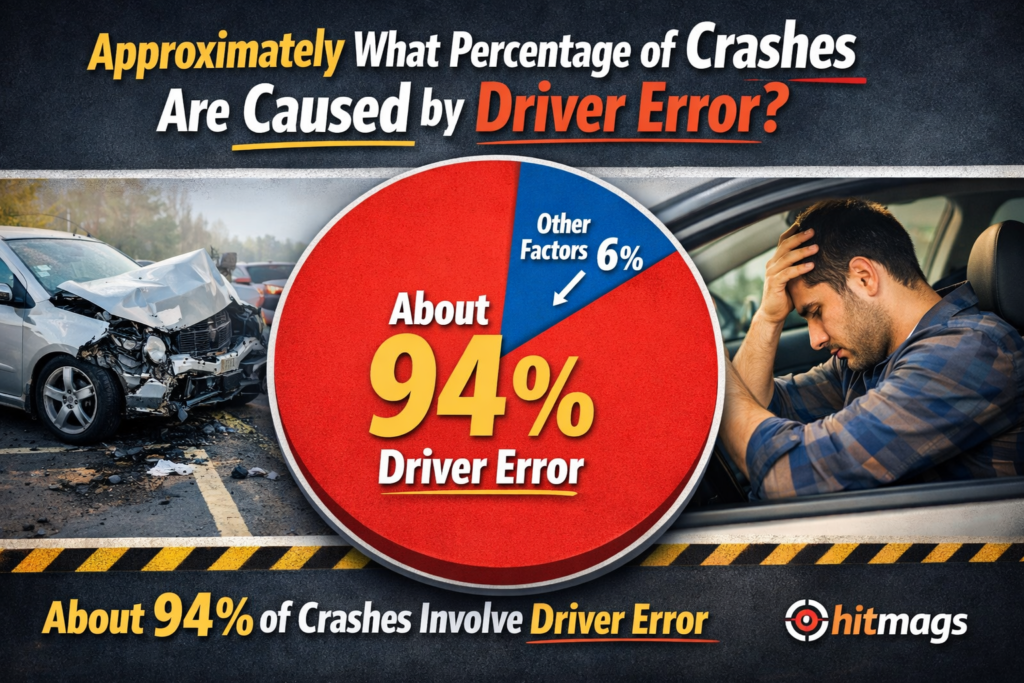
Car crashes are one of the most common and serious risks people face every day on the road. Understanding why crashes happen is not only interesting but also critical for improving road safety and preventing injuries or deaths. Many people ask, “Approximately what percentage of crashes are caused by driver error?” and the answer is eye-opening. Research shows that the overwhelming majority of traffic accidents—often cited as around 90 to 94 percent—involve some form of human error. This does not mean that vehicles, weather, or road conditions are never a factor, but human mistakes are the main contributors. From distracted driving and fatigue to poor judgment or risky behavior, driver errors can quickly turn a small mistake into a serious accident. In this article, we will explore these causes in detail, look at statistics from around the world, examine common myths, and discuss ways to prevent crashes caused by driver error. By understanding these factors, drivers can become more aware, cautious, and proactive in keeping themselves and others safe.
How Driver Error Is Defined in Crash Research
Understanding how driver error is defined in crash research is crucial to making sense of the statistics that show driver mistakes are responsible for the majority of traffic accidents. In road safety studies, driver error is considered any action or inaction by the driver that contributes to a crash. This includes a wide range of behaviors, from failing to notice a red light to misjudging the speed of an oncoming vehicle or losing control of a car in difficult conditions. Researchers often categorize these errors into several types to better analyze their impact. Recognition errors occur when drivers fail to perceive hazards in time, decision errors involve poor judgment or risky choices, performance errors are mistakes in handling the vehicle, and non-performance errors include factors like fatigue or medical conditions that affect driving ability. By examining these categories, experts can pinpoint not only how crashes happen but also why certain types of errors are more common and more dangerous. This understanding forms the basis for policies, training, and technology aimed at reducing accidents caused by driver mistakes.
The definition of driver error is not limited to one simple action, but rather encompasses a spectrum of behaviors that collectively lead to crashes. Even when environmental factors like weather or road conditions play a role, driver error is often a critical factor in the outcome. For example, a slippery road may contribute to a crash, but the driver’s failure to adjust speed, maintain distance, or react appropriately is usually what turns a minor slip into a serious accident. Similarly, mechanical failures rarely cause crashes on their own, but if a driver does not respond correctly to a brake failure or tire blowout, the situation can quickly escalate. By defining driver error broadly and analyzing its many forms, researchers can better understand why it is responsible for such a large percentage of crashes. This knowledge emphasizes the importance of education, awareness, and technology in helping drivers make safer choices and prevent accidents before they happen.
Breakdown — Types of Driver Errors That Lead to Crashes
When examining the types of driver errors that lead to crashes, it becomes clear that most accidents are the result of everyday mistakes that drivers make, often without realizing the potential consequences. One of the most common causes is distracted driving, which can include anything from using a mobile phone, adjusting the radio, interacting with passengers, or even daydreaming while behind the wheel. Even a few seconds of inattention can dramatically increase the risk of a collision, as drivers may fail to notice brake lights, traffic signs, or changes in road conditions. Speeding is another major contributor, as it reduces the time available to react to hazards and increases the severity of any crash that occurs. Poor judgment, such as miscalculating gaps in traffic or attempting unsafe lane changes, also plays a significant role. Additionally, driving under the influence of alcohol or drugs impairs coordination, reaction time, and decision-making, making accidents far more likely. Fatigue is an often-overlooked factor, as drowsy driving slows reflexes and reduces alertness, contributing to crashes that could otherwise have been avoided with proper rest.
While these errors are distinct, they often overlap in real-world situations, making crashes the result of multiple contributing mistakes rather than a single cause. For instance, a driver who is tired may also be more prone to distraction, fail to judge the speed of an approaching vehicle correctly, and react slowly to sudden obstacles, compounding the risk. Misjudgment can also be affected by environmental conditions like rain, snow, or poorly maintained roads, but human error is usually the decisive factor that determines whether an accident occurs. Studies show that almost every serious crash can be traced back to one or more of these driver errors, reinforcing why human behavior is the most critical area to address for road safety. By understanding these patterns, drivers, educators, and policymakers can target interventions more effectively, whether through awareness campaigns, stricter enforcement of traffic laws, or technology designed to reduce human error and assist drivers in making safer choices.
Why Human Error Is So Dominant Compared to Other Crash Causes
The reason human error dominates as the primary cause of crashes lies in the complex nature of driving and the limitations of human perception and decision-making. Driving requires constant attention, quick judgment, and precise control, and even small lapses can have serious consequences. While vehicles themselves are built to high safety standards and road conditions are generally engineered for protection, it is the driver who ultimately controls the vehicle and responds to dynamic situations on the road. Mechanical failures, such as brake or tire problems, are relatively rare and usually preventable through maintenance, and environmental factors like weather or poor road conditions often contribute only indirectly. Even in these situations, it is often a driver’s error that determines whether an accident occurs. For example, a wet road may increase stopping distance, but a crash is far more likely if a driver does not reduce speed or maintain a safe following distance. The human element, with its potential for distraction, misjudgment, or fatigue, therefore becomes the decisive factor in the majority of traffic accidents.
Another reason human error is so prevalent in crash statistics is that drivers are responsible for reacting to countless variables at once, from other vehicles and pedestrians to traffic signals and road signs. Unlike automated systems, humans are prone to cognitive overload and can only process limited information at a time. Even experienced drivers can make mistakes when unexpected situations arise or when they are tired, stressed, or distracted. Studies consistently show that over 90 percent of crashes involve some form of human error, highlighting that while other factors may contribute, it is the driver’s response—or lack of an appropriate response—that often leads to a collision. This dominance of human error underscores the importance of education, defensive driving, and technological aids like automatic emergency braking, lane departure warnings, and driver monitoring systems. By addressing the human factors that lead to mistakes, society can reduce the number and severity of accidents, making roads safer for everyone.
Regional and International Perspectives
When looking at regional and international perspectives on driver error and crash causes, it becomes clear that human mistakes are a global issue affecting every country, though the exact percentages may vary depending on local traffic conditions, road infrastructure, and driving culture. In the United States, studies consistently report that approximately 90 to 94 percent of all traffic crashes involve driver error, making it the dominant factor in road accidents. Similar patterns are seen in European countries, where research shows that human mistakes account for roughly 88 to 92 percent of crashes. In countries with rapidly growing vehicle populations, such as India or Brazil, driver error is also the leading cause, although inconsistent road conditions and varying levels of law enforcement can influence accident rates. Even in nations with advanced traffic management systems and strict driving regulations, human error remains the main contributor, demonstrating that technology and infrastructure alone cannot fully eliminate the risks posed by drivers’ mistakes. Understanding these patterns helps policymakers and road safety organizations tailor interventions and campaigns to the specific behaviors and challenges in their regions.
Cultural and regulatory differences also play a role in how driver error contributes to crashes around the world. For example, countries with strict enforcement against speeding, drunk driving, and distracted driving often see lower rates of accidents, but even there, human mistakes remain the primary cause of serious collisions. In contrast, regions with less rigorous enforcement or higher rates of risky driving behavior may experience more frequent accidents stemming from fatigue, distraction, or poor judgment. International studies highlight that while the external environment—such as road quality, weather, or vehicle maintenance—can affect accident likelihood, the human element consistently emerges as the critical factor. This global perspective reinforces the idea that driver behavior is the key to reducing crashes, and emphasizes the importance of educational campaigns, stricter enforcement, and innovative technologies designed to assist drivers in making safer choices on every road.
Common Myths About Crash Causes
There are many misconceptions about what causes traffic accidents, and understanding these common myths about crash causes is important for anyone who wants to drive safely and reduce risk on the road. One widespread myth is that most crashes are caused by bad weather, such as rain, snow, or fog. While adverse weather can make driving more challenging, studies show that weather alone is rarely the primary cause of crashes. In almost every case, human error is the critical factor. Drivers may fail to adjust their speed for rain, not leave enough space for braking on icy roads, or misjudge visibility in foggy conditions. Another common misconception is that vehicle defects are a major contributor to accidents. While mechanical failures like brake problems or tire blowouts can occur, these account for only a very small percentage of crashes, often around two percent, and even in these situations, the driver’s response largely determines whether a collision happens. Misunderstanding these statistics can lead drivers to underestimate the importance of their own behavior and overestimate external factors, which ultimately increases risk on the road.
Another myth is that experienced drivers are immune to causing accidents, or that minor mistakes rarely lead to serious consequences. In reality, even highly skilled drivers can make errors, especially when distracted, fatigued, or under pressure. Studies show that errors such as failing to notice traffic signs, misjudging gaps, or reacting too slowly are common across all age and experience levels. Some people also believe that advanced safety technology in modern cars, such as lane departure warnings or automatic braking, completely prevents crashes. While these technologies can reduce risk and mitigate human error, they are not a replacement for attentive driving and good judgment. By debunking these myths, drivers can gain a more realistic understanding of road safety and the role of human error, which is essential for making safer choices, avoiding complacency, and supporting policies and technologies aimed at reducing crashes caused by driver mistakes.
Conclusion — The Bottom Line on Driver Error and Crash Statistics
In conclusion, understanding approximately what percentage of crashes are caused by driver error highlights one of the most important realities of road safety: the vast majority of accidents result from human mistakes rather than vehicle defects or environmental conditions. Research consistently shows that between 90 and 94 percent of all traffic crashes involve some form of driver error, including distracted driving, fatigue, poor judgment, speeding, and impaired driving. These errors are not limited to inexperienced drivers; even seasoned motorists can make mistakes that lead to serious accidents. Recognizing the dominant role of human behavior in crashes emphasizes the need for drivers to remain vigilant, adopt safe driving habits, and continuously improve their awareness and decision-making skills. By focusing on the human factor, policymakers, educators, and technology developers can work together to create safer roads and reduce the physical, emotional, and financial costs associated with traffic accidents.
Ultimately, the message is clear: driver error is the single largest contributor to traffic crashes worldwide, and addressing it should be the priority for improving road safety. This understanding drives the need for ongoing education, stronger enforcement of traffic laws, and the integration of advanced safety technologies in vehicles. While we cannot completely eliminate mistakes, we can significantly reduce the frequency and severity of accidents by targeting the behaviors that cause them. By spreading awareness, encouraging responsible driving, and supporting innovations that assist drivers, society can work toward roads where accidents are less common and safer outcomes are more achievable. Knowing the statistics and taking proactive steps empowers drivers to make better choices and demonstrates that understanding how human error impacts crashes is not just about numbers, but about saving lives every day.